
Chinese medicine · Knowledge & care
Moxibustion: The Art of Warmth, the Practice of Care
By jan · Updated
Moxibustion: The Art of Warmth, the Practice of Care
1. An ember in a long tradition
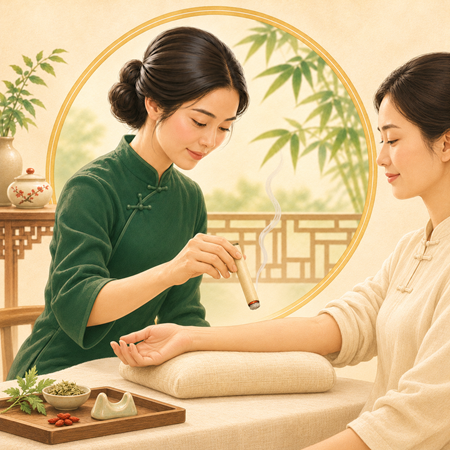
A small ember glows at the end of a moxa stick. In a quiet treatment room, the practitioner watches the skin and listens to the person receiving care. The scene carries something of the hearth into medicine: warmth, attention and the patient rhythm of an inherited craft. Moxibustion is a form of local heat treatment that traditionally uses burning mugwort near, or in some methods on, selected areas of the body.[1]
Its appeal is easy to understand. Yet the value of a modern appointment rests on more than atmosphere. It depends on a clear reason for treatment, an appropriate method and an honest explanation of what research can and cannot tell us.
2. From mugwort leaf to moxa
One distinction helps clarify the terminology: Ai Ye means the mugwort leaf used in Chinese herbal medicine, rather than the treatment itself. The Chinese Pharmacopoeia identifies Ai Ye as the dried leaf of Artemisia argyi.[2] Leaves are processed into material for moxa cones, rolls and other preparations. The Chinese term ai jiu, 艾灸, refers to moxibustion.
Moxibustion belongs to the same broad medical tradition as acupuncture, but it applies heat rather than requiring needle insertion. UNESCO recognised acupuncture and moxibustion of traditional Chinese medicine as intangible cultural heritage in 2010.[3] That recognition honours knowledge and transmission across generations; clinical effectiveness remains a separate question requiring clinical evidence.
3. Different ways to apply warmth
In indirect moxibustion, burning moxa is separated from the skin, for example by holding a stick above the treatment area or using a suitable holder or intervening material. Direct moxibustion uses small cones placed on the skin. Some traditional direct techniques intentionally produce a burn or scar, an important distinction that must be explained before consent.[3], [4]
Another method combines moxa with an acupuncture needle and requires specific training and protection from falling ash.[4] These approaches differ in exposure, sensation and risk. A name such as “gentle” or “indirect” does not remove the possibility of a burn. Ask which method is proposed and why it suits the clinical goal.
4. Traditional meaning, modern questions
Traditional explanations often describe warming the channels, supporting yang and encouraging the movement of qi and blood.[4] Like sunlight returning to a cold courtyard, warmth provides a powerful image for renewed movement. These descriptions belong to the language of TCM; they are not direct measurements of organ function or a diagnosis of poor circulation.
From a biomedical perspective, the immediate intervention is local heat.[1] Whether a particular method has useful effects beyond those of warmth, attention and expectations must be tested. A soothing sensation does not establish that medicinal substances have reached deep organs. Nor can a proposed biological mechanism, by itself, prove that a treatment improves health.
5. What research says about knee pain
Knee osteoarthritis is one area with clinical research. A placebo-controlled trial involving 110 participants found greater improvement in pain with active moxibustion than with a sham device. Improvements in physical function were also reported at several assessments, although the difference was no longer statistically significant at the final 24-week assessment.[5]
A 2026 network meta-analysis nevertheless rated the evidence comparing moxibustion methods as low to very low certainty, with no clear overall winner among techniques.[6] This supports cautious discussion of possible symptom relief, not claims of cartilage repair or a cure for arthritis. If moxibustion is considered, its benefit should be judged alongside exercise, appropriate medical care and the person's ability to move and manage daily life.
6. Digestive symptoms: a focused question
Research has also examined particular digestive conditions. A 2022 sham-controlled trial enrolled 104 people with diarrhoea-predominant irritable bowel syndrome. More participants receiving active moxibustion reported adequate symptom relief after six weeks, and differences persisted during follow-up. Quality-of-life and anxiety/depression outcomes did not differ significantly between groups.[7]
These findings concern a defined condition and a specific protocol. They do not establish a general ability to “strengthen digestion”, treat every cause of diarrhoea or boost immunity. Broader confidence requires consistent results across well-designed studies and populations. Persistent digestive symptoms deserve a diagnosis; a pleasant warming treatment should not become a reason to postpone that assessment.
7. A particular application in pregnancy
Moxibustion has been studied when a baby is in breech position. A 2023 Cochrane review of 13 studies concluded that adding it to usual care probably reduces non-head-first presentation at birth, but probably makes little or no difference to caesarean birth rates. Reporting of adverse effects was insufficient to establish safety confidently.[8]
This is a specific obstetric question, not a general recommendation for pregnancy. Any consideration of moxibustion should involve the maternity team and a suitably trained practitioner. It should not replace antenatal assessment, discussion of external cephalic version or planning for a safe birth. An online description cannot determine whether it is appropriate for an individual pregnancy.
8. What a thoughtful appointment involves
Before treatment, discuss symptoms, diagnoses, medicines, allergies and previous reactions to heat or smoke. Mention pregnancy, asthma, diabetes, numbness or reduced skin sensation. Difficulty sensing heat requires particular caution because discomfort may not provide a reliable warning.[4] The practitioner should explain the method, expected sensations, alternatives and risks, and obtain informed consent.[11]
Agree on a useful goal, such as greater comfort during a particular activity, and when to review progress. During treatment, warmth should be monitored rather than endured. Report excessive heat, stinging, dizziness, cough or breathing discomfort immediately. Care should be adjusted or stopped when necessary, with attention to privacy, comfortable positioning and protection of clothing and skin.
9. Heat, smoke and a well-prepared room
Burns, allergic reactions and infections are recognised risks of moxibustion.[9] Indirect application still needs careful supervision. Skin protection, safe handling of embers and appropriate equipment are part of professional care.[11] A blister or worsening skin reaction should be assessed, rather than presented as proof that treatment worked.
Burning moxa also releases air pollutants. Emissions vary by product, and products described as “smokeless” are not necessarily emission-free.[10] Good ventilation or suitable extraction matters, especially for practitioners exposed throughout the working day. Tell the clinic about smoke sensitivity before booking. Discuss another approach if smoke causes symptoms; tradition is best respected through care for the person, including the air they breathe.
10. Choosing moxibustion care in Thailand
When exploring practitioners by province, ask about qualifications, moxibustion training, the method offered, ventilation and fees. A useful consultation explains why heat is being considered for your concern and how its effects will be reviewed. If acupuncture, tuina or herbal medicine is proposed alongside it, each part of the plan should have a clear purpose.
There is no universal schedule that suits every person, and adding more treatments does not automatically improve results. Look for a practitioner who welcomes questions and coordinates with other healthcare professionals when needed. The enduring attraction of moxibustion lies in its simplicity. Its place in modern care depends on informed choice, careful practice and results that matter in everyday life.
