
Chinese medicine · Knowledge & care
Food Therapy in TCM: Nourishment, Tradition and Everyday Care
By jan · Updated
Food Therapy in TCM: Nourishment, Tradition and Everyday Care
1. Where nourishment begins
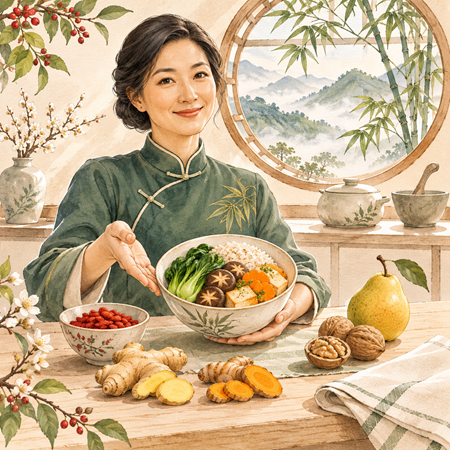
Before a recipe reaches the page, it often lives in a kitchen: ginger warming in a pan, steam rising from rice, a few red berries brightening a bowl. Across generations, Chinese food traditions have connected these ordinary moments with care. A meal can express hospitality, mark a season and make room for someone whose appetite or daily rhythm has changed.
In Traditional Chinese Medicine, food therapy is known as shiliao, 食疗. Its practical appeal begins with attention to what and how we eat. The phrase “medicinal foods” needs care, however. Everyday ingredients, prescribed herbs and concentrated extracts are not interchangeable. Chinese medicine itself distinguishes the broad nourishing role of food from the more specific use of herbal medicines.[1] This distinction makes the tradition easier to enjoy thoughtfully, without turning every meal into a prescription.
2. Understanding the traditional language of food
TCM describes foods through qualities such as warming, cooling or neutral, and through five flavours: sour, bitter, sweet, pungent and salty. Ginger, for example, belongs to the warming tradition. Practitioners consider these qualities alongside an individual's constitution and patterns of symptoms.[2] The imagery evokes a warming bowl in a cold season or a lighter meal on a heavy day.
These categories are traditional interpretive concepts. They do not replace nutrient analysis, allergy assessment or a medical diagnosis. “Warming” is not simply the temperature at which a dish is served; “sweet” is not an instruction to add sugar. Nor does a traditional reference to an organ necessarily describe an anatomical disease of that organ. A useful consultation explains this language clearly and keeps it compatible with adequate, varied nutrition.
3. Build the meal before adding the special ingredient
The foundation remains a varied eating pattern: vegetables, fruit, whole grains, pulses and suitable protein sources, with attention to salt, free sugars and the quality of fats. WHO guidance supports this broad approach.[3] A pinch of turmeric cannot compensate for a diet that routinely lacks variety, and a costly tonic is not a substitute for sufficient food.
In practice, look at the whole bowl. Rice or another grain provides a base; vegetables add variety; tofu, beans, fish, eggs or another suitable protein make it more complete. Adjust choices to appetite, preferences, allergies and individual needs. A clear broth and a substantial soup are different meals, even if both smell wonderfully of herbs. Ask what is actually being eaten, not only what has been simmered. This question connects traditional care with contemporary nutrition.
4. Ginger: familiar warmth and a closer look at nausea
Ginger, jiang (姜), brings fragrance and a lively pungency to soups, steamed fish and vegetable dishes. The part commonly called a root is a rhizome, an underground stem. Its traditional warming character makes it a familiar bridge between the kitchen and Chinese medical practice.[2], [4] Finely sliced ginger makes an ordinary dish inviting.
Research suggests that ginger may help pregnancy-related nausea and vomiting, but most studies have tested supplements rather than normal meals. Findings for other kinds of nausea are less consistent.[4] A homemade infusion therefore should not be treated as equivalent to a studied preparation. Ginger can also cause heartburn or stomach discomfort. Enjoy it as a flavour you tolerate; discuss products intended to treat symptoms with a healthcare professional, particularly during pregnancy or when taking medicines.
5. Goji berries: colour, flavour and measured expectations
Goji berries, gouqizi (枸杞子), add a soft sweetness and a striking red accent. Dried berries can be used as a modest garnish in porridge or soups. Their appeal does not require a promise of longevity. Like other dried fruit, they are best considered as food within the overall meal, rather than as a licence to eat unlimited quantities.
Goji contains carotenoids, including zeaxanthin. A small, unblinded pilot trial in healthy adults reported changes in macular pigment, a measurement relevant to the retina, after regular berry consumption.[5] This is an interesting signal, not proof that goji prevents blindness or replaces eye care. Safety also depends on context: case reports describe increased anticoagulant effects in people taking warfarin who consumed goji products.[6] Anyone using warfarin should seek professional advice before adding these berries, juices or teas.
6. Turmeric: a golden spice and a different kind of extract
Turmeric, jianghuang (姜黄), gives dishes an earthy aroma and golden colour. It can be used in rice, vegetables or soups, with the amount guided by taste. Curcumin is one of its constituents, but the spice in a saucepan is not equivalent to a capsule containing a concentrated, absorption-enhanced formulation.
Studies of turmeric or curcumin products for knee osteoarthritis show encouraging early findings, while product differences and limitations in the evidence make firm conclusions difficult.[7] These results do not establish a therapeutic dose of curry. Liver injury has also been documented with turmeric supplements.[8] This is a reason to assess the specific product and its purpose, rather than to assume that “natural” means harmless or that ordinary seasoning has the same exposure. For everyday cooking, turmeric can simply be valued for what it contributes to the meal.
7. Reishi: a medicinal fungus, not an everyday vegetable
Reishi, lingzhi (灵芝), occupies a distinctive place in East Asian medical culture. Its glossy form and association with vitality have made it a memorable symbol. In modern use, it commonly appears as powders, teas, capsules or extracts.[9] It belongs in a more careful conversation than the edible mushrooms chosen for an ordinary stir-fry.
Laboratory findings about immune activity do not establish that a reishi product prevents infections, reliably improves sleep or extends life. Products and clinical findings vary. Reported adverse effects include nausea, insomnia and liver injury; interactions are a concern with anticoagulants and immunosuppressants.[9] A description such as “adaptogen” should not be read as proof of a general stress-protective effect. Reishi extracts are therefore not a routine smoothie addition in the meal ideas below. A practitioner should explain the reason for their use, the evidence and the relevant precautions.
8. Astragalus: traditional nourishment requires individual judgement
Astragalus, huangqi (黄芪), is traditionally described as a qi-tonifying herb. Its root may appear in herbal preparations and some traditional soups. That culinary setting does not automatically make it suitable for everyone or establish that it prevents colds and influenza. Putting a medicinal ingredient into broth does not remove its pharmacological relevance.
NCCIH concludes that reliable evidence is insufficient to establish astragalus's usefulness for a health condition. Some studies suggest biological effects, but important quality limitations remain. People with autoimmune disease should avoid it, and it may interact with immunosuppressive medicines. Safety in pregnancy and breastfeeding is also uncertain.[10] These concerns favour an individual assessment rather than a seasonal recommendation for the entire household. A nourishing soup needs no astragalus. Discuss any proposed clinical use separately from the meal.
9. Give ordinary ingredients their proper place
A useful pantry needs no rare treasures. Rice, oats, beans, tofu, leafy vegetables, carrots, pears and familiar edible mushrooms provide many possibilities. Nuts and seeds can add texture where allergies permit. Beans and soy foods are useful protein options; the nutritional value of a protein food also depends on the fibre, fats and other components accompanying it.[11] Variety matters more than the reputation of one ingredient.
Consider how foods work together. Mushrooms bring flavour and texture, while tofu or beans can supply the main protein in a plant-based dish. A pear offers a different eating experience from a sweetened bottled drink. Frozen vegetables and pantry foods also have a place. Traditional cooking becomes sustainable when it fits a person's budget, time and tastes. Imported “superfoods” are unnecessary.
10. Three gentle ways to begin in your own kitchen
A savoury breakfast: prepare rice porridge or oats with tofu or a fully cooked egg, vegetables and a little ginger. Adapt the texture to preference. This is a meal idea, not a treatment for a diagnosed digestive disorder; plain porridge alone may need other foods alongside it to make breakfast more substantial.
A colourful main meal: serve rice with leafy greens, carrots and beans, tofu or fish. Use turmeric and ginger as seasonings if you enjoy them. Flavour need not depend on a large quantity of salty sauces or sweet glazes.
A simple fruit finish: enjoy fresh or gently cooked pear, perhaps with a few goji berries if they are appropriate for you. Added sugar is optional, and supplements are unnecessary. These examples invite experimentation with ordinary ingredients. They are not herbal prescriptions, detox regimens or substitutes for a personalised nutrition plan.
11. Care continues after the cooking is finished
Food safety deserves a place beside tradition, especially when meals are prepared in advance. Use safe water, wash produce, keep raw foods separate from ready-to-eat foods and cook thoroughly. WHO's food-safety guidance emphasises these simple habits.[12] Choose clearly identified ingredients from reliable suppliers; a familiar name or an attractive market display is not a botanical identification system.
Refrigerate perishable food promptly. Do not leave it at room temperature for more than two hours, or more than one hour when the temperature exceeds about 32°C, a relevant consideration in Thailand.[14] Divide large batches into smaller containers for easier cooling, and follow storage instructions. Dried berries, grains and herbs also need protection from dampness and mould. Ginger or another aromatic ingredient does not preserve an otherwise unsafe meal.
12. When food advice needs a wider clinical view
A food-based approach should make eating more workable, not create anxiety or an ever-growing list of forbidden foods. Tell your practitioner about allergies, prescribed medicines, supplements, pregnancy and existing medical conditions. Bring the actual product label when discussing an extract. Supplements can interact with medicines, and many have not been adequately studied in children, pregnancy or breastfeeding.[13]
A qualified dietitian can help assess nutritional adequacy and condition-specific needs, while a suitably trained TCM practitioner can explain traditional reasoning. Coordination is particularly useful when symptoms persist or a medical diet is already in place. Do not replace prescribed treatment with a tea or tonic. Agree on a clear aim, such as making meals more varied or easier to prepare, and review changes without assuming that every fluctuation in symptoms comes from a single food. The person, rather than a fashionable ingredient, belongs at the centre of the plan.
13. Finding a nourishing path in Thailand
When exploring TCM practitioners by province, ask how dietary advice is developed and how it fits with your existing care. Look for clear explanations, attention to medicines and allergies, realistic expectations and respect for your cultural preferences. Good guidance distinguishes a food suggestion from a medicinal prescription and tells you when another healthcare professional should be involved.
The pleasure of this tradition can remain wonderfully ordinary: choosing ingredients, learning a family recipe, sharing a meal and noticing what fits your life. Its richest promise is not hidden in one berry, root or mushroom. It lies in a pattern of thoughtful nourishment that can be sustained. Let the kitchen offer colour, comfort and curiosity, while evidence and individual needs guide the claims made for health.
